
OpenChamber Bets Your Coding Agent Doesn't Need a Terminal
The MIT-licensed opencode frontend signals the real fight in AI coding: the supervision layer, not the harness.

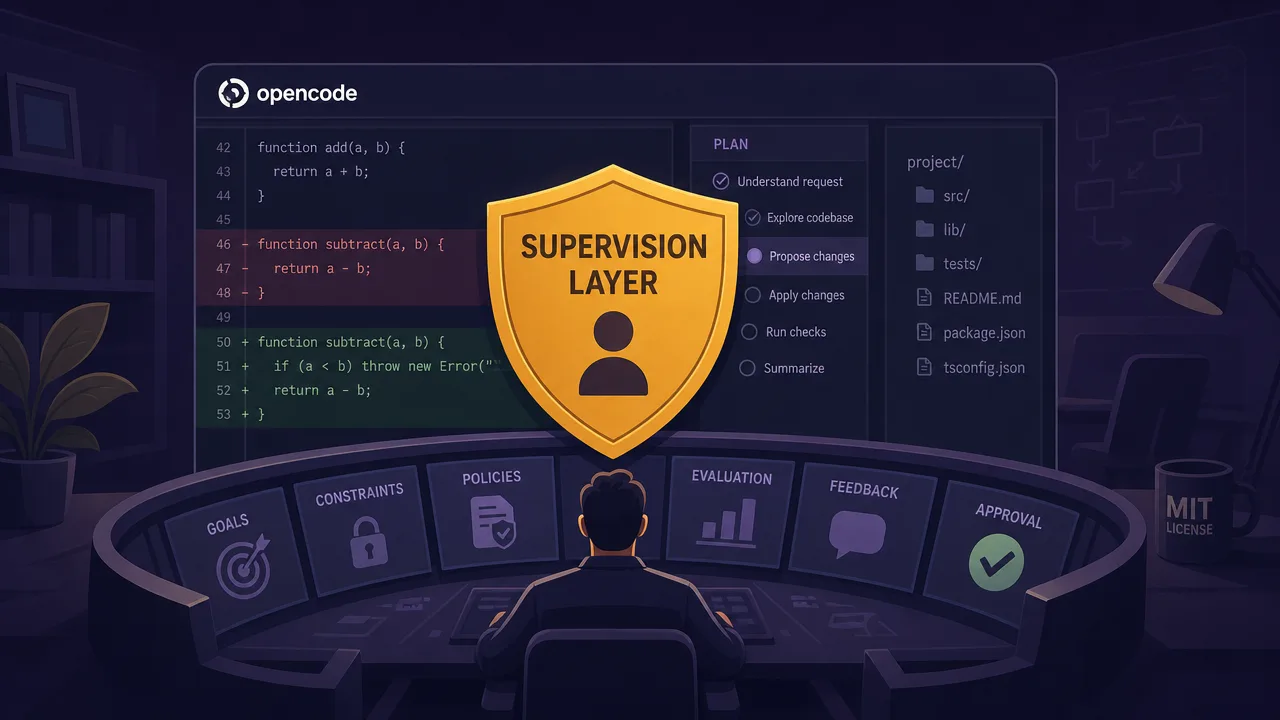
For two years the answer to "what's the best UI for an AI coding agent" has been "a terminal, obviously." OpenChamber, an MIT-licensed "agentic development environment" that hit the Hacker News front page this week, is the strongest argument yet that the terminal was a phase, not a destination — and that the interesting competition in AI coding has quietly moved from the agent itself to the layer that supervises it.
OpenChamber is a free, open-source workspace — desktop app for macOS, Windows, and Linux, a browser PWA, a VS Code extension, and a beta mobile app — that wraps opencode, the popular open-source coding agent from the SST team. It doesn't ship its own agent, its own model, or its own subscription. Everything it does rides on whatever providers you've already configured in opencode. The project is independent, unaffiliated with the opencode team, and has pulled in nearly 8,000 GitHub stars.
The harness and the surface are splitting apart
The structurally important thing about OpenChamber isn't any single feature. It's that the project exists at all.
Every serious coding agent until recently was a sealed unit: the harness (the loop that plans, calls tools, edits files) and the surface (the thing you look at) shipped together. Claude Code is a harness with a TUI welded on. Cursor is a harness with an editor welded on. opencode broke that pattern by building client/server from the start — the agent runs as a headless process with an API, and the TUI is just one client. OpenChamber is what happens when someone takes that seriously: a full-blown third-party frontend, built by an outsider, iterating at its own pace (v1.18.1 shipped August 4, five releases in the last two weeks of July alone).
We've seen this movie. The Language Server Protocol decoupled language intelligence from editors, and within a few years the smart part became shared infrastructure while editors competed on experience. The same fault line is opening in agentic coding. Harnesses are converging — everyone has plan mode, subagents, worktree isolation, MCP. The genuinely unsolved problems are all on the surface: how you supervise five concurrent runs, how you review a 2,000-line diff you didn't write, how you check on a session from your phone. That's exactly the ground OpenChamber is claiming.
What it does that your terminal doesn't
The features worth your attention are the supervision primitives, because they map to real workflow gaps:
- Session Goals. You give a session a finish line; after every turn OpenChamber evaluates the result and keeps the agent working until the goal is met, blocked, or hits a limit you set. This is the "ralph loop" people have been hand-rolling in bash, productized with a budget cap.
- Multi-run. One prompt fans out to up to five models in separate sessions, optionally in isolated git worktrees; you keep the best result or merge the strongest parts. Teams do this today with tmux panes and worktree scripts. Having it as a first-class primitive — with a diff view built for comparing outcomes — is a real ergonomic win.
- Changes Walkthrough. Instead of a raw diff, large changes get reordered into a sequence of explained stops. Review is the actual bottleneck of agentic coding in 2026, and this is one of the few earnest attempts to redesign it rather than bolt a chat panel onto a diff viewer.
- Private Relay. Pair a phone or laptop with a one-time QR code and reach sessions running on your desktop over an end-to-end encrypted tunnel — no open ports, no public server. Sessions keep running when you close the lid.
Adoption is cheap to try: install opencode (curl -fsSL https://opencode.ai/install | bash), then grab a desktop build from the GitHub releases or run the web version (Node 22+ required). Your existing opencode config, providers, and auth carry over untouched. If you're on Claude Code, the calculus is different — see below.
The catch: it's married to one harness
OpenChamber's biggest design decision is also its biggest strategic risk: it speaks only opencode. Conductor made the opposite bet on the Mac, orchestrating parallel Claude Code agents; newer entrants in the HN thread (Paseo, Orca) are pitching multi-harness support as the differentiator. If you believe harnesses are commoditizing, single-harness lock-in on the surface layer looks backwards — the whole point of a great supervision UI is that it shouldn't care which loop does the typing. Nobody running Claude Code with a Max subscription is switching harnesses to get a nicer review screen.
The HN reception flagged real maturity issues too: a reported memory leak that forced reboots after long sessions, a dependency tree north of fifty npm packages for something that touches your code and credentials, and grumbling that "built on opencode" is disclosed less prominently than it should be. And it's one independent developer's project — the release velocity is impressive, but so is the bus factor.
Where this lands
My read: the category is real, this specific tool is early. The pattern of one developer directing several concurrent agents is now the default for heavy users, and terminals genuinely are the wrong tool for supervising it — you can't glance at five TUIs from a phone. Something shaped like OpenChamber will be standard kit within a year.
Whether it's OpenChamber depends on a race: can an independent, single-harness project out-execute both the harness vendors moving up the stack (opencode ships its own desktop app; Anthropic keeps thickening Claude Code's surfaces) and the harness-agnostic orchestrators moving down? History says the LSP moment rewards the neutral layer, not the first mover. If you're already an opencode user, install it today — it's free, local-first, and strictly better than juggling terminals. Everyone else should watch for one signal: the day OpenChamber (or a rival) supports its second harness. That's when the ADE stops being an accessory and becomes the thing you choose first.
Sources & further reading
- OpenChamber: Agentic Development Environment for AI Coding — openchamber.dev
- OpenChamber: An Agentic Development Environment — news.ycombinator.com
- openchamber/openchamber: Desktop and web interface for OpenCode AI agent — github.com
- OpenChamber — dsebastien.net
Lenn writes about cloud platforms, Kubernetes internals, and the infrastructure decisions that quietly make or break engineering organizations. Based in Berlin's vibrant tech scene, they have a talent for turning dense platform-engineering topics into prose that people actually finish reading.
Discussion 0
No comments yet
Be the first to weigh in.


